AI-First Content Architecture: Building a Trusted Content Library to Win AI Answers and Google Rankings in 2026
The best AI content strategy for 2026 rankings pairs AI research speed with human expertise, pillar-cluster architecture, and citation-ready answers.
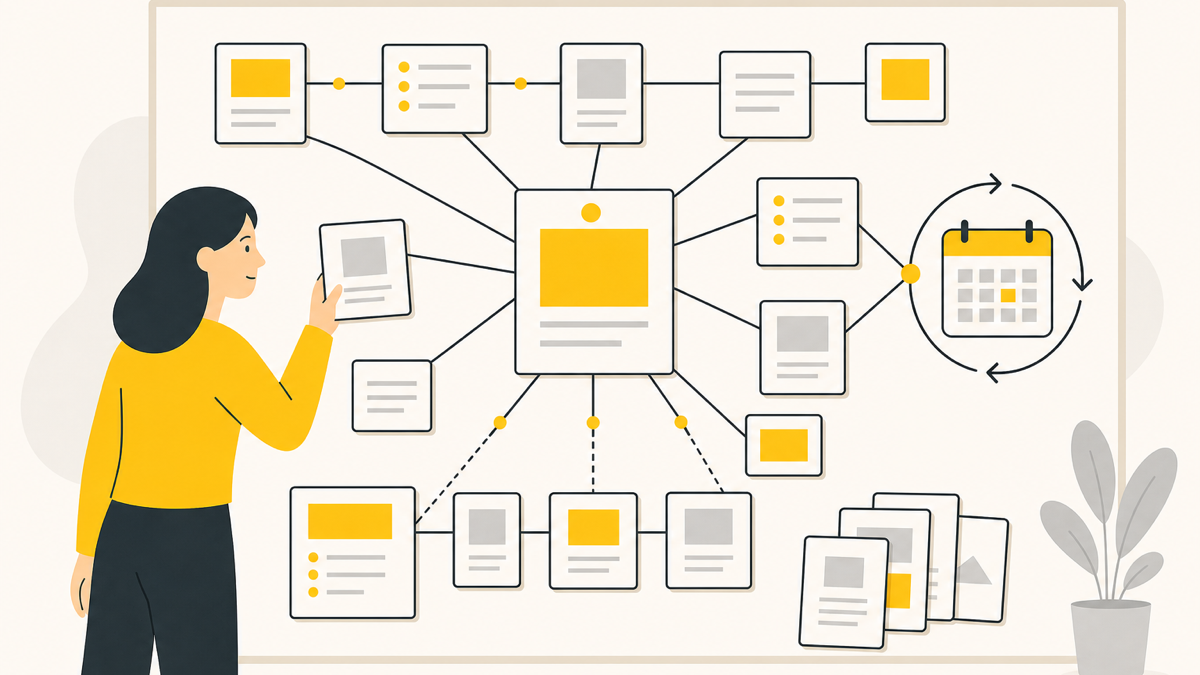
The AI content strategy that actually increases search rankings in 2026 is a hybrid architecture: AI handles research, briefs, and drafting speed, while human subject-matter experts inject first-hand experience, proprietary data, and editorial judgment before anything publishes. Pure AI output alone consistently ranks lower and gets cited less by both Google and chatbots.
Most teams either flood their blog with AI drafts that quietly sink after the next core update, or they stick to slow, all-human production and lose ground to competitors publishing twice as often. Neither extreme survives contact with how Google's ranking systems and answer engines like ChatGPT actually retrieve and grade content today. The fix is a structured content library — pillar-and-cluster architecture, explicit answer blocks, and freshness governance — engineered to be the trusted source both algorithms reach for.
Table of Contents
- What Is an AI-First Content Architecture, and Why Does It Win in 2026?
- Why Hybrid Content Beats Pure AI in the Rankings
- Pillar-and-Cluster Architecture: The Blueprint for Topical Authority
- Writing AI-Friendly Answer Blocks That Win Citations
- The Experience-Injection Workflow: A Repeatable Production Process
- Governance and Freshness: Keeping the Library Trusted Through 2026
- Comparing the Five AI Content Strategies Head to Head
- Which Approach Fits Your Team?
What Is an AI-First Content Architecture, and Why Does It Win in 2026?
An AI-first content architecture is a structured library — a central pillar page supported by linked cluster pages, each carrying explicit sourcing and a scheduled freshness review — built so Google's ranking systems and AI answer engines can retrieve it, trust it, and cite it as the definitive answer to a buyer's question. It's a system, not a writing shortcut.
Most advice on this topic still treats "AI content strategy" as a question of which prompt produces a better draft. That framing misses the point entirely. Google has said directly that generative AI itself confers no ranking advantage — what matters is whether the finished page is useful, original, and trustworthy, regardless of the tool used to write it, according to Google's own guidance on generative AI content. An architecture built around that reality looks different from a content calendar built around output volume.
 A team mapping pillar-and-cluster topics before a single draft gets written.
How This Differs From Generic "AI Content" Advice
Generic advice stops at "use AI to write faster, then edit it." An architecture goes further: it defines which questions deserve a pillar page, which deserve a cluster page, what data each page must contain that a language model can't invent on its own, and how often each page gets revisited. Adoption of AI tools in SEO workflows is now near-universal — Aira's State of SEO survey found 86% of SEO professionals use AI tools regularly, but 87% of that same group keep human editors directly involved in production, which tells you the industry already treats AI as a co-pilot, not a replacement.
The 2026 Baseline: What Actually Changed
Through 2023 and 2024, plenty of sites tested whether volume alone could win rankings. It couldn't, and Google formalized that answer with its scaled content abuse policy, which applies "regardless of whether AI or humans produced" the pages in question, according to Google's spam policies documentation. By 2025, Google published a dedicated generative-AI optimization guide confirming that retrieval-augmented generation and query fan-out pull from the same core index and ranking systems used for normal search results, per Google's AI optimization guide. As Google's Search Liaison Danny Sullivan has put it, the company does not penalize content simply because AI wrote it — it penalizes content that lacks original value, accuracy, and usefulness to the person reading it. That's the baseline every architecture decision below is built against.
Practical rule: if a competitor's AI tool could produce your draft word-for-word from public information, don't publish it until a person with real experience has added something that tool couldn't know.
Why Hybrid Content Beats Pure AI in the Rankings
Hybrid content — AI-assisted drafting with substantive human editing and first-hand input — outperforms both pure AI output and slow all-human production because it combines speed with the originality signals Google's systems reward. The data on this isn't close, and it isn't new anymore either.
The Ranking Gap at Position #1
An analysis of 42,000 blog pages found that content sitting in the #1 ranking position is 80% human-written or heavily human-led, while purely AI-generated content reaches position #1 only 9% of the time, according to Semrush's research on AI content performance. A separate 16-month study tracking 4,200 articles found pure AI content ranked 23% lower on average than human-written pieces, while AI-assisted content with real editorial input landed within 4% of pure human writing — close enough that speed becomes the deciding factor, not quality.
The Backlink and Deindexation Penalty
Here's the gap most AI content advice skips entirely: pure AI articles earn 61% fewer editorial backlinks than human-written or human-edited pieces covering the same topic. Since backlinks remain one of the strongest ranking signals Google uses, that's a structural disadvantage no amount of on-page optimization fixes. Unedited AI content also suffers a 3.2x higher rate of deindexation following major core and spam updates compared with hybrid or human content, based on the same longitudinal tracking.
Rand Fishkin of SparkToro frames the shift bluntly: with over half of searches now ending without a click, the goal isn't just ranking anymore — it's becoming the source AI models trust enough to cite by name. That's a different bar than "rank on page one," and it's one pure AI drafts rarely clear on their own.
Field note: teams that measure success by article count instead of citation rate almost always end up with a large library and a shrinking share of qualified traffic.
Pillar-and-Cluster Architecture: The Blueprint for Topical Authority
A pillar-and-cluster architecture organizes a single comprehensive guide (the pillar) alongside a set of narrower, internally linked pages (the clusters) that each answer one specific sub-question in depth. This structure signals topical authority to Google's ranking systems far more reliably than dozens of disconnected articles targeting keyword variations.
 Mapping cluster pages around a pillar guide before assigning writers.
Building the Pillar Page
The pillar page should be the most comprehensive resource on its topic that your audience can find anywhere, including from competitors. A working checklist for a strong pillar:
- Covers every major sub-topic a buyer would need before making a decision.
- Links out to each cluster page using descriptive, question-based anchor text.
- Includes at least one piece of information — a proprietary benchmark, a customer example, an original test — that doesn't exist elsewhere online.
- States clearly who wrote it and what qualifies them to speak on the topic.
- Carries a visible "last reviewed" date, updated on a real schedule, not just at initial publish.
Google's own guidance on non-commodity content backs this directly: "unique, valuable, good content" tends to share attributes like a distinct point of view and organization that genuinely helps readers navigate the topic, according to Google's AI optimization guide.
Structuring Cluster Pages Without Cannibalization
Cluster pages fail most often not because they're poorly written but because they overlap with each other and confuse Google about which page should rank for which query. To avoid that:
- Assign each cluster page one primary question and one primary keyword intent before drafting begins.
- Check existing cluster pages for overlapping intent before publishing a new one.
- Link every cluster page back to the pillar and sideways to two or three closely related clusters, never more.
- Retire or merge cluster pages that consistently rank for the same query as another page on the site.
Practical rule: if two pages on your site could both reasonably answer the same search query, merge them. Google will pick one anyway, and it's rarely the newer one.
Writing AI-Friendly Answer Blocks That Win Citations
An AI-friendly answer block is a concise, self-contained paragraph near the top of a section that directly answers the implied question, states its source, and can be lifted cleanly by a retrieval system without losing meaning. This is the single highest-leverage formatting change most content libraries haven't made yet.
The Anatomy of a Citable Answer Block
Google's generative features rely on retrieval-augmented generation, pulling specific passages from indexed pages rather than summarizing entire sites, a mechanism Google describes plainly in its guidance on AI Overviews and AI Mode. To be the passage that gets pulled:
- Answer the question in the first one to two sentences, before any throat-clearing.
- Keep the core claim under 50 words so it can be extracted whole.
- Attribute any statistic or claim to a named, linkable source in the same sentence.
- Follow the answer block with supporting detail, not the other way around.
This matters more now than it did two years ago. Google AI Overviews now appear on a meaningful share of informational queries, and when one shows up, organic click-through on the traditional top result can drop by 50 to 60%. Content that isn't structured to be quoted inside that summary effectively loses the click before the searcher ever sees a blue link.
Structured Data and Explicit Sourcing
Schema markup doesn't replace good writing, but it removes ambiguity for machine crawlers trying to parse context. Google specifically recommends validating structured data against its policies rather than treating it as decorative, per its guidance on AI-generated content. Pair FAQ or Article schema with visible author bylines and cited sources in the body text itself — machine readability and human trust signals should point at the same evidence, not different ones.
Field note: pages that cite a named source for every claim get pulled into AI answer summaries noticeably more often than pages making the same claims with no attribution at all.
The Experience-Injection Workflow: A Repeatable Production Process
Experience injection is the practice of deliberately adding first-hand detail — original data, named quotes, tested examples — into an AI-assisted draft at a specific stage of production, rather than hoping it appears organically during editing. Without a defined stage for it, it usually doesn't happen at all.
Step-by-Step Production Flow
- Scan for the question. Identify a real buyer question competitors are currently winning, ideally from live search and chatbot behavior rather than keyword volume alone.
- Research and outline with AI. Use AI to map subtopics, competing pages, and gaps in existing coverage.
- Assign a subject-matter expert. Someone with direct experience in the topic reviews the outline and adds what only they would know.
- Draft with AI, guided by that input. The draft is written around the expert's contribution, not bolted together afterward.
- Fact-check and verify every claim. Every statistic gets a named, linkable source before it survives into the next draft.
- Edit for structure and answer blocks. Rewrite openings so each section answers its implied question in the first sentences.
- Publish with visible authorship. Byline, credentials, and a review date go live with the page, not added later.
- Monitor and revisit on a schedule. Search Console and ranking data determine which pages get updated first.
Where Human Experts Must Touch the Draft
Not every page needs a full rewrite by hand, but every page needs a human checkpoint at three specific points: before publishing (fact accuracy), at the first sign of ranking decline (relevance), and on a fixed freshness schedule regardless of performance (trust). AI-assisted content with this kind of editing landed within 4% of pure human writing in ranking performance, essentially closing the gap that pure AI output can't close alone.
Practical rule: assign a named human owner to every pillar page. "The content team" isn't an owner; a person with a calendar reminder is.
Governance and Freshness: Keeping the Library Trusted Through 2026
Governance is the set of recurring processes — weekly question scanning, scheduled content reviews, and decay monitoring — that keeps a content library from going stale the moment it's published. Without it, even a well-built pillar-and-cluster architecture degrades within a year as competitors update and search behavior shifts.
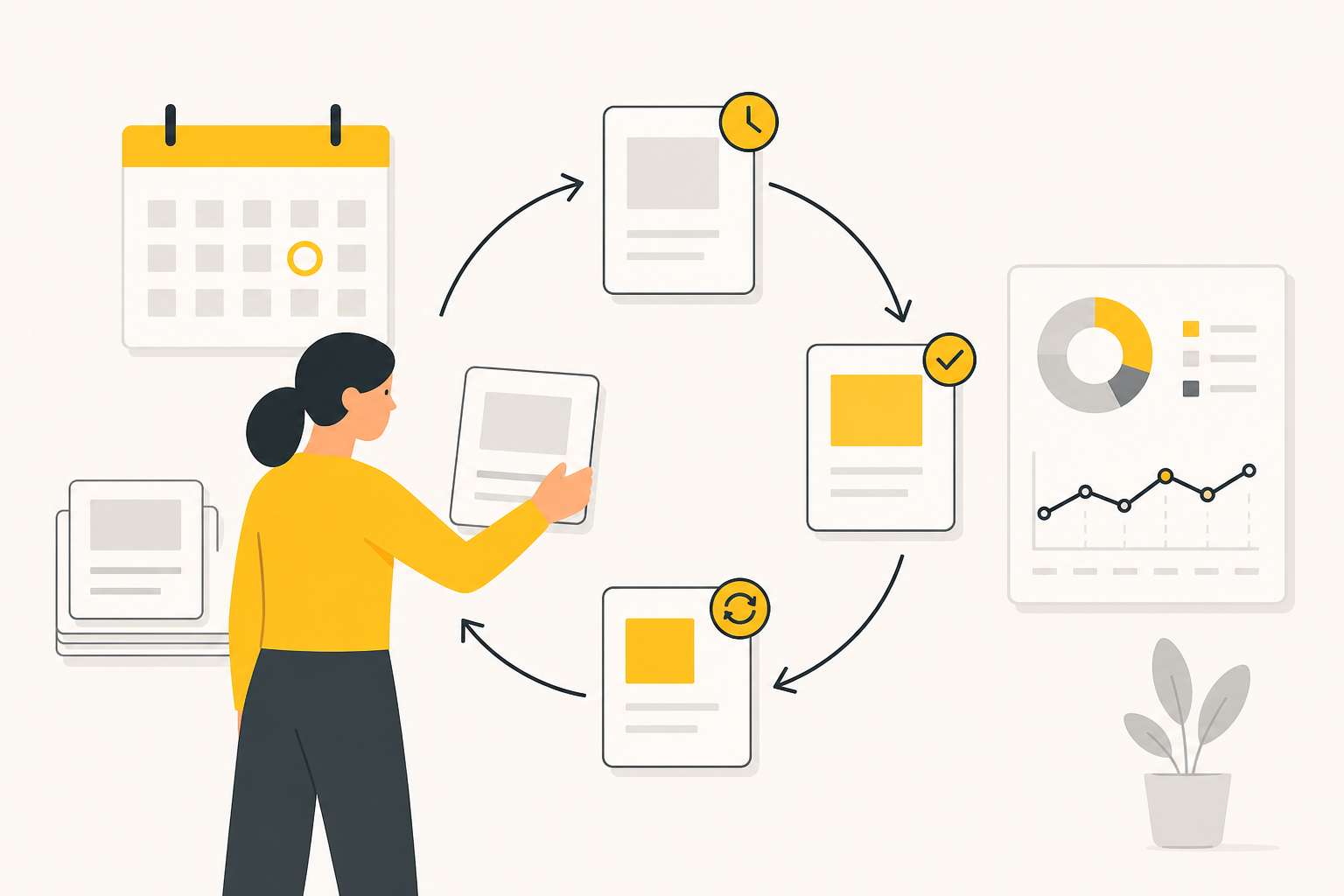 Scheduling recurring reviews so no page goes stale unnoticed.
Weekly Buyer-Question Scanning
Search behavior and chatbot defaults shift faster than most publishing calendars account for. A weekly scan of live search results and AI model answers — tracking which buyer questions still surface competitor pages instead of yours — keeps the content roadmap tied to actual demand rather than a keyword list built once a year and never revisited.
Freshness Signals That Matter to Google and AI Models
- Update statistics and examples at least twice a year on any page that ranks for a commercial or high-intent query.
- Re-verify every external link annually; broken citations quietly erode trust signals.
- Revisit author credentials and bylines when a subject-matter expert leaves or roles change.
- Track ranking and citation decay in Search Console monthly, not quarterly.
- Retire pages that no longer reflect current practice rather than leaving them live and wrong.
Google's scaled content abuse policy specifically targets large volumes of low-effort or unoriginal pages regardless of who or what produced them, per its spam policies — which means a governance process that quietly prunes weak pages is protective, not just tidy.
Field note: the sites that hold rankings through core updates are rarely the ones that publish the most. They're the ones that revisit the oldest pages the most consistently.
Comparing the Five AI Content Strategies Head to Head
No single approach fits every team, but the performance differences between the five common strategies are large enough to matter for planning. The table below reflects the ranking, citation, and risk data covered throughout this article.
| Strategy | Position #1 potential | Backlink acquisition | Deindexation risk | AI citation likelihood |
|---|---|---|---|---|
| Mass AI publishing, no editing | Very low (~9%) | Weak | High (3.2x baseline) | Low |
| AI-assisted clusters, light editing | Moderate | Below average | Moderate | Moderate |
| Human-only writing | High but slow to scale | Strong | Low | Moderate |
| Hybrid: experience-injected workflow | High (~80% of #1 spots) | Strong | Low | High |
| Hybrid + GEO-optimized answer blocks | High | Strong | Low | Highest |
When Pure AI Still Has a Narrow Use Case
Pure AI output isn't worthless everywhere. Internal documentation, low-stakes product FAQs with no competitive search intent, or first-draft outlines that a human will substantially rewrite anyway can reasonably skip heavy human involvement. The moment a page targets a query with commercial intent or competitive AI Overview visibility, that shortcut stops paying off.
Why Hybrid + GEO Wins for B2B and SaaS
B2B buyers research longer and cite more sources before a purchase decision than typical consumer searchers, which means the pages that win are the ones that show up consistently across both traditional rankings and AI answer summaries. Hybrid content with explicit answer blocks captures both channels at once, rather than optimizing for one and hoping the other follows.
Which Approach Fits Your Team?
The right entry point into this architecture depends less on company size and more on who owns the content decision and what they're being measured against. Here's how the approach adapts across the teams most commonly building this kind of library.
B2B SaaS Companies
For B2B SaaS, the priority is winning buyer-question queries at the consideration stage, where AI Overviews and chatbot answers increasingly intercept traffic before a prospect ever reaches a comparison page. Building pillar guides around core use cases, with clusters covering integrations, alternatives, and pricing questions, tends to produce the fastest movement in both rankings and AI citation rate.
Marketing and Content Teams
Content teams already stretched across channels benefit most from the weekly scanning step, since it removes the guesswork of deciding what to write next. The bottleneck usually isn't ideas, it's knowing which existing competitor answer is actually beatable this month, and prioritizing accordingly rather than working straight down a static keyword list.
Founders and CMOs
For founders and CMOs, the useful metric shift is moving away from raw traffic and toward citation and conversion tracking on commercial-intent pages. A smaller, well-governed library that gets cited in AI answers and converts at a normal rate beats a large one that ranks for informational queries with no buying intent behind them.
Building and maintaining this kind of architecture by hand, every week, across scanning, drafting, expert review, and freshness audits, is a lot to sustain internally alongside a full content calendar. EasyScale runs exactly this process — weekly buyer-question scans, expert-informed drafts, and governance reporting — for B2B and SaaS teams who want the library built and kept current without adding it to an already full plate.