Hiring for AI-Driven SEO and Publishing in 2026: How to Choose a Partner Who Makes Your Brand the AI's Top Answer
Who should you hire for AI-driven SEO and content publishing in 2026? A practical framework for picking the right partner, not just a tool.
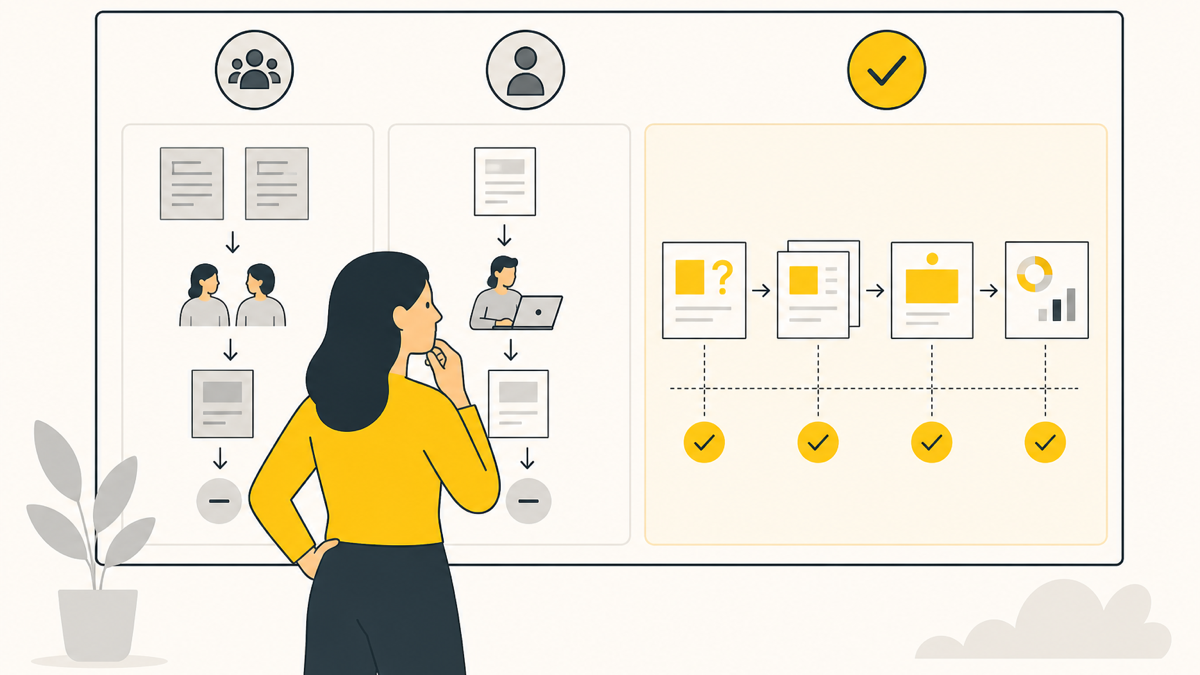
The best hire for AI-driven SEO and content publishing in 2026 is a single accountable partner who combines continuous buyer-question research, editorially rigorous writing, direct publishing into your existing CMS, and ongoing monitoring of how Google, ChatGPT, and Gemini answer questions about your category. Not a freelancer who only drafts, not a tool that only generates text, not an agency that only reports keyword rankings.
Most marketing teams have already tried some mix of an in-house writer, a generalist SEO agency, and a handful of AI drafting tools, and still find that when they ask ChatGPT or Gemini a buying question, a competitor gets named — or worse, a random Reddit thread does. That gap between "we publish content" and "we get recommended" is now the whole game. This piece walks through exactly which capabilities to hire for, which hiring model fits which company, and the questions that separate a real AI-search partner from a repackaged content mill.
Table of Contents
- What Changed in Search by 2026, and Why It Changes Who You Hire
- In-House Team, Agency, or Hybrid Partner: Three Hiring Models Compared
- The Five Capabilities Your AI SEO and Content Partner Must Prove
- Comparing Your Options Side by Side
- The Hiring Checklist: What to Ask Before You Sign a Contract
- Red Flags That Signal You're About to Hire the Wrong Partner
- Who This Hiring Advice Fits Best in 2026
What Changed in Search by 2026, and Why It Changes Who You Hire
As of 2026, a large share of buyer research never reaches a results page at all — it happens inside an AI answer, and whoever gets cited there wins the visit that actually matters. Hiring the right partner starts with accepting that ranking on page one and being the recommended answer inside ChatGPT or Gemini are now two different jobs, requiring two different sets of proof.
 A team checking how their brand actually shows up across search and AI answers, not just where it ranks.
Zero-Click Search and the Answer-Engine Shift
Roughly six in ten Google searches now end without a click to any website, because AI Overviews and direct answers satisfy the query on the results page itself, according to a breakdown of 2026 AI SEO trends from Searchbloom. That number alone explains why a traffic report built only around blue-link rankings is becoming misleading. A page-one ranking can still produce fewer sessions than last year if the AI-generated answer above it already told the reader what they needed.
The traffic that does arrive from AI platforms behaves differently, too. Previsible's AI Traffic Report puts AI referral growth above 500% year over year, and separately finds that visitors arriving from ChatGPT, Perplexity, or Gemini convert at rates several times higher than a typical organic session, in some cases more than 20 times higher. A visitor who reaches your site because a model just recommended you by name is much further along than someone who typed a broad keyword into a search box.
Practical rule: If a prompt about your category returns a Reddit thread before it returns your homepage, that's not a content problem you fix with one article. It's a visibility gap that needs monitoring, not guesswork.
Where AI Models Actually Pull Their Answers From
Models don't invent opinions about your category from nothing. They lean on whatever content has the clearest entity signals, the most consistent citations, and the most direct answers to the exact question someone asked. That's frequently a forum thread, a comparison page from a competitor, or a listicle from an industry publication, not a brand's own site. Digital Elevator's research into the sources that drive AI brand discovery points to the same pattern: offsite signals, structured comparisons, and clear topical authority carry more weight in generative answers than raw domain age or backlink count ever did in classic SEO.
This is precisely why a hire built around 2022-era SEO habits — keyword volume, backlink outreach, quarterly content calendars — misses the point. The job in 2026 is to consistently show up as the cited, named answer across three different systems (Google, ChatGPT, Gemini) that each update their sourcing behavior on their own schedule.
In-House Team, Agency, or Hybrid Partner: Three Hiring Models Compared
There are really only three ways to staff this function: build a dedicated in-house unit, hand it entirely to an outside agency, or run a hybrid model where an internal owner directs an external partner. Most mid-market and B2B SaaS teams do best with the hybrid model; only enterprises with regulatory complexity or unusually technical products tend to justify the in-house build.
 Building in-house versus bringing in a dedicated partner usually comes down to available hands, not ambition.
Building an In-House AI-SEO Unit
If you go this route, plan on hiring three distinct roles rather than one generalist who is expected to do everything:
- An AI/GEO SEO strategist who owns entity mapping, topic clustering, and winning citations across Google AI Overviews, ChatGPT, and Perplexity.
- A content editor or subject matter expert who rewrites raw drafts, injects proprietary data and real examples, and enforces experience-based credibility so the writing doesn't read like generic AI output.
- An automation or workflow specialist who connects research, drafting, and your CMS (WordPress, Webflow, or a custom stack) into a repeatable publishing pipeline instead of a manual copy-paste process.
Moz's analysis of SEO industry hiring found that roughly half of all full-time SEO job postings now explicitly require AI search or LLM fluency, and that standalone "prompt engineer" titles have actually declined by about 30% even as that skill gets folded into broader strategist and editor roles. That's the clearest signal that the market has already moved past hiring a single AI specialist and toward hiring people who can do strategy, editing, and automation as one integrated job.
Field note: Teams that hire one AI-SEO generalist and expect them to also run editorial standards, technical SEO, and monthly reporting almost always burn that person out within two quarters.
If you're also deciding which tools to keep running alongside whichever staffing model you choose, our breakdown of SEO tool mix ROI for SaaS companies is worth reading before you finalize a budget.
The Hybrid Operating Model
In the hybrid setup, an internal marketing or product lead keeps ownership of positioning, proprietary data, and final sign-off, while an external partner runs the research cadence, the writing, the CMS publishing, and the AI-visibility monitoring. This is the model most B2B SaaS and mid-market companies land on, because it keeps brand judgment inside the building while outsourcing the operational load of weekly research and high-volume production, which is genuinely hard to staff for cheaply.
The risk with this model isn't the split of labor, it's ambiguity about who owns quality control. Before signing anything, get in writing who has final approval over a published article, and how disagreements about accuracy or tone get resolved.
The Five Capabilities Your AI SEO and Content Partner Must Prove
Regardless of hiring model, any candidate should be able to demonstrate five specific capabilities: continuous topic discovery tied to real buyer questions, fast and editorially rigorous production, direct publishing into your CMS, ongoing monitoring across Google and AI models, and transparent reporting that connects content choices to visibility and revenue.
Continuous Topic Discovery Tied to Real Buyer Questions
A one-time keyword audit is not a research process. Buyer questions and the AI answers to them shift week to week as models update, so the discovery process needs to run continuously, not quarterly. Ask any candidate to show you a live example of how they found a question where a competitor currently gets recommended, and what they'd do about it in the next two weeks. If they can only describe a process in the abstract, they haven't actually run one.
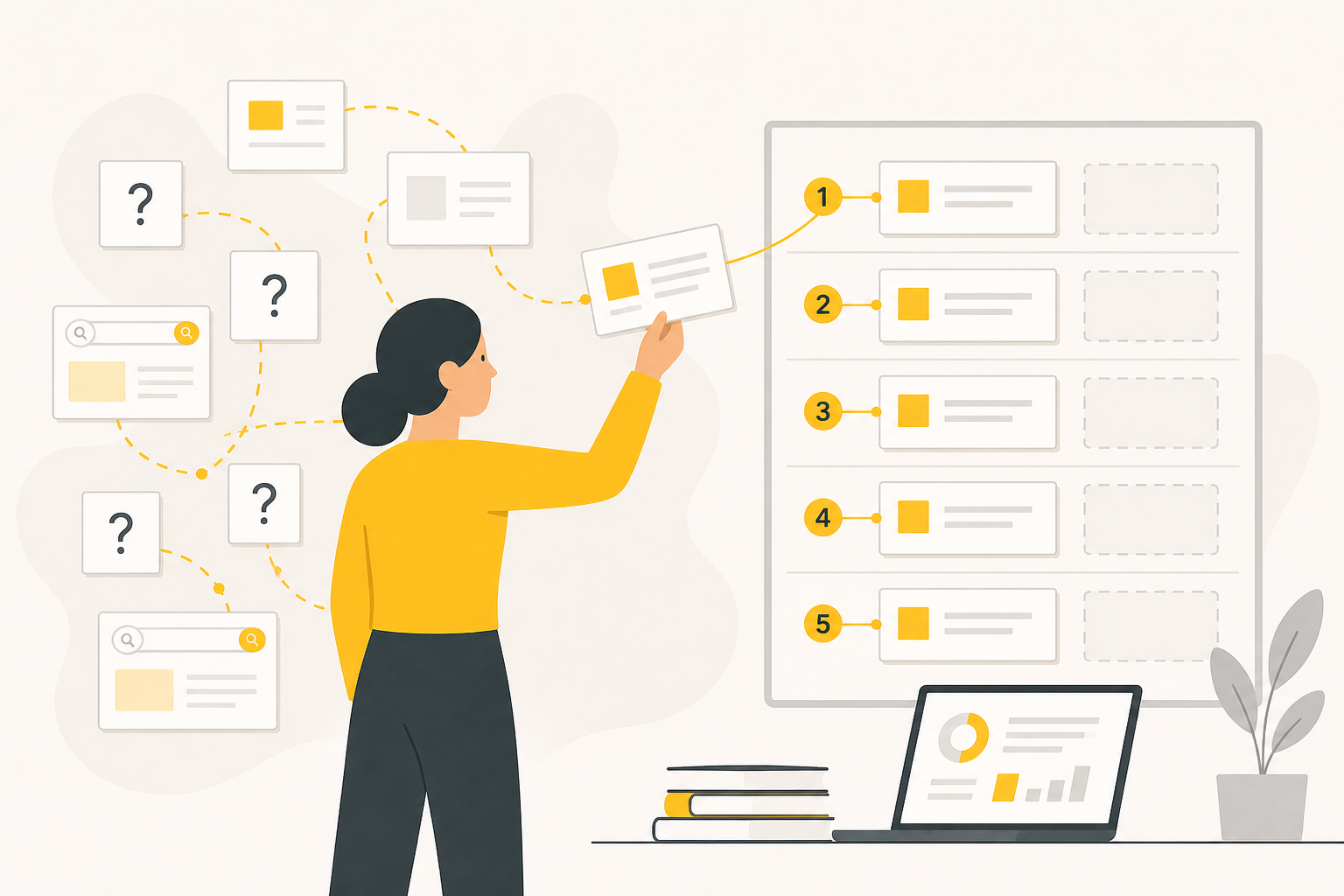 Weekly research into which buyer questions competitors are winning, rather than a one-time keyword list.
Editorial Governance and Human-in-the-Loop Review
Raw AI drafting without review is the single biggest reason AI-driven content programs underperform. One survey of marketing teams found that 36.4% of companies relying on largely unedited AI content reported declining organic traffic, while the top-performing teams — about 62% of them — run a deliberate human-in-the-loop workflow rather than full automation. Our own view on this, laid out in more depth in AI-First Content Architecture, is that the workflow itself needs to be explicit and repeatable:
- Data injection — pull in your product specifics, customer language, and any proprietary data or examples.
- AI-assisted drafting — generate a structured first draft against a brief, not a blank prompt.
- Fact-checking and subject matter review — a human with real domain knowledge corrects claims and adds nuance a model can't invent.
- Entity and schema optimization — make sure the piece is structured so both search crawlers and AI models can parse who you are and what you're claiming.
- Publishing and internal linking — ship it directly into the CMS, connected to related pages, not sitting in a shared drive waiting for someone to copy it over.
Practical rule: If nobody on the team can explain why a specific paragraph exists, in whose voice, and with what evidence, the content isn't ready to publish.
Dave Gerhardt, founder of Exit Five and former CMO at Drift and Privy, described what this looks like when it works: "I've got high standards for great content and have been able to trust the team to build upon my voice and scale content production. I was hesitant at first about outsourcing content since I wanted to maintain my distinct style, but they've effectively captured that," he said of his experience working with an outside content partner, a comment shared on Omniscient Digital's site. That's the bar: production speed without losing the voice that makes the content credible in the first place.
An analysis of firms specializing in generative-engine work from Percepture makes a similar point about what separates agencies that survive this transition from the ones repackaging old service menus: the winners treat entity clarity and topical depth as data-analysis problems, not just writing problems.
Comparing Your Options Side by Side
Every hiring path — in-house build, boutique AI SEO agency, enterprise technical shop, freelance specialist, or a full-service AI content and publishing partner — trades off speed, cost, and control differently, and none of them is universally correct. The table below lines up the five most common options against the criteria that actually predict whether a hire will move AI-search visibility, not just traffic.
| Hiring option | Speed to launch | Typical monthly cost | AI-visibility monitoring | Editorial quality control | Best fit |
|---|---|---|---|---|---|
| In-house AI-SEO unit (3 roles) | Slow (2–4 months to hire and ramp) | $15k–$30k+ in salary | Only as good as the tooling you build | High, if you hire well | Enterprises, regulated industries, complex products |
| Boutique AI SEO / content agency | Moderate (2–6 weeks) | $5k–$15k | Varies widely by firm | Moderate to high | Mid-market teams needing strategy plus production |
| Enterprise technical SEO shop | Slow (onboarding-heavy) | $15k+ | Strong on technical/entity signals, weaker on content velocity | High, but content-light | Large, technically complex sites |
| Freelance / fractional specialist | Fast (days) | Under $5k | Limited, usually manual | Depends entirely on the individual | Very small teams, narrow scope |
| Full-service AI content and publishing partner | Fast (1–2 weeks) | $5k–$15k+ depending on volume | Built-in, ongoing across Google/ChatGPT/Gemini | High, with defined review steps | Growing B2B SaaS teams wanting one accountable owner |
How to Read the Tradeoffs
Cost and speed are the easy variables to compare; monitoring and editorial control are the ones people skip and later regret. A cheap freelancer with no monitoring process will produce articles that read fine but never get checked against how ChatGPT or Gemini is actually answering questions in your category this month. An enterprise technical shop might fix your structured data beautifully and still hand you generic articles nobody wants to read. The partner worth paying for closes both gaps at once.
What "End-to-End" Actually Means
"End-to-end" gets used loosely. It should mean: research happens on a recurring cadence, articles get written to an editorial standard, publishing happens directly into your CMS without a manual handoff, and a dashboard ties all of it back to rankings, AI citations, and ideally pipeline. Anything short of that is a partial service wearing a full-service label.
Austin Distel, senior director of marketing at Jasper, put a number on what this can be worth when it's done properly: "We've published over 100 articles which has also directly led to new business. We've created over $4M in annual recurring revenue through our blog," he said in a case study published by Omniscient Digital. That kind of outcome doesn't come from volume alone; it comes from volume paired with a research process that keeps targeting the right questions.
The Hiring Checklist: What to Ask Before You Sign a Contract
Before signing with anyone, run through a short, specific checklist rather than relying on a sales deck or a client logo wall. The goal is to force concrete answers, not confident-sounding generalities, on workflow, governance, and measurement.
Questions About Workflow and Governance
- Where exactly does AI do the work, and where does a human review it?
- Can you show me your last two content briefs and the final published articles side by side?
- Who has final sign-off on accuracy and brand voice, and what happens when we disagree?
- How do you handle topics that require real subject matter expertise we don't have documented anywhere?
- Do you publish directly into our CMS, or do we receive files to upload ourselves?
Questions About Measurement and Reporting
- How often do you re-check how ChatGPT, Gemini, and Google AI Overviews answer our category's core questions?
- Can you show a real example of a brand mention or citation you helped win inside an AI answer?
- What does your monthly report actually tie together: traffic, rankings, AI citations, or pipeline?
Field note: Ask any finalist to pull up their scan from last week for one of your category's prompts. If they can't produce it on the call, they're not monitoring anything, they're just producing content and hoping.
If you're building this shortlist right now, how to choose a content creation service for more organic leads covers the production-quality side of vetting in more depth.
Red Flags That Signal You're About to Hire the Wrong Partner
The fastest way to waste a budget on this is to hire based on volume promises or a tool-name checklist instead of a demonstrated process. Two patterns show up constantly among underperforming engagements: fully automated "no human touch" pitches, and reporting that only shows vanity metrics with no connection to AI citations.
The "100% Automated" Pitch
Any agency or freelancer promising hundreds of AI-written articles a month with no editorial layer should be treated with real skepticism. A widely shared discussion on r/ContentMarketing captures the practitioner consensus well: the agencies actually delivering results use AI to scale research, clustering, and drafting, but keep human strategy, subject matter review, and brand judgment firmly in the loop. Full automation without review isn't a shortcut, it's a way to publish content that AI models themselves learn to discount.
Vanity Metrics Without Citation Tracking
The second red flag is a reporting dashboard that only shows session counts and keyword position, with nothing about whether the content is actually getting cited inside AI answers. A firm serious about this work should be able to show, concretely, how they evaluate AI Overview visibility, LLM citations, technical foundation, content authority, and documented outcomes as separate, trackable line items, the same structure Bridgeway Digital uses in its own assessment criteria for AI SEO agencies. If a partner can't break their own reporting down that specifically, they likely aren't tracking it that specifically either.
Practical rule: Volume promises without a citation-tracking dashboard are a warning sign, not a selling point.
Worth noting too: the freelance market has adjusted to this reality faster than a lot of agencies have. Listings on platforms like Upwork increasingly specify AI search optimization and citation tracking as distinct, named skills, not a generic "SEO writer" tag, which tells you where the actual demand has moved.
Who This Hiring Advice Fits Best in 2026
The right hiring model shifts depending on which seat you sit in, because the constraint each team faces (budget, headcount, technical complexity, or reporting pressure) is different even when the goal — getting recommended by AI models and search — is the same.
 The right hiring model looks different depending on which seat you sit in.
B2B SaaS Companies
For B2B SaaS teams, the hybrid model wins most often: keep a marketing lead who owns positioning and product truth, and bring in a partner who runs the weekly research, writing, and publishing cadence. SaaS buying cycles involve heavy pre-sales research, and that's exactly the research AI models now intercept before a prospect ever reaches your site.
Product and Growth Teams
Growth teams should care most about the connection between content and pipeline, not article count. Push any partner to report citation wins and qualified-lead attribution alongside traffic, and treat a rising publish count with no pipeline signal as a reason to ask harder questions, not a reason to celebrate.
Marketing and Content Teams
In-house content teams often already have the brand voice and subject matter access; what they usually lack is the operational capacity for weekly AI-model monitoring and high-volume publishing. A partner that plugs directly into your CMS and existing style guide, rather than working around them, is the better fit than one that wants to run an entirely separate content operation.
In-House SEO Teams
Existing SEO teams should focus their own time on technical foundations, structured data, and internal linking architecture, and hand off the recurring content production and AI-prompt monitoring to a partner built for that cadence. Trying to do both well with the same one or two people is the most common reason in-house programs stall out after an initial burst of publishing.
Founders and CMOs
Founders and CMOs should evaluate this decision the way they'd evaluate any revenue-adjacent hire: ask for a documented process, a real citation example, and a reporting cadence, not a promise of volume. The companies that get cited consistently inside AI answers by the end of 2026 will be the ones that treated this as an operating system to build, not a one-off project to check off.
EasyScale was built around exactly this gap: weekly scans of how Google, ChatGPT, and Gemini answer your category's buyer questions, 12 to 30 articles a month written to an editorial standard and published directly into your existing CMS, and a monthly dashboard that ties those choices back to search and AI-answer visibility. If the framework above is the one you want to hire against, it's worth a conversation to see whether that model fits your team.